P&L in Insurance: Understanding Financial Statements for Agencies

What’s a Profit and Loss Statement in Insurance?
Other businesses use a profit and loss statement to track sales revenue, costs, and operating expenses for profitability. However, insurance agencies use it to track commissions, renewals, carrier payouts, and policy-based income and expenses over time.
For independent insurance agents, keeping track of your finances is key to growing your business. One way to do this is by reviewing your P&L in insurance. But how do you understand all the numbers? By understanding this financial statement, you can assess where your money is coming from and where it’s going. Whether you run your agency or work with others, knowing how to read these statements is important for making smart financial choices.
What Your P&L Reveals About Revenue and Expenses
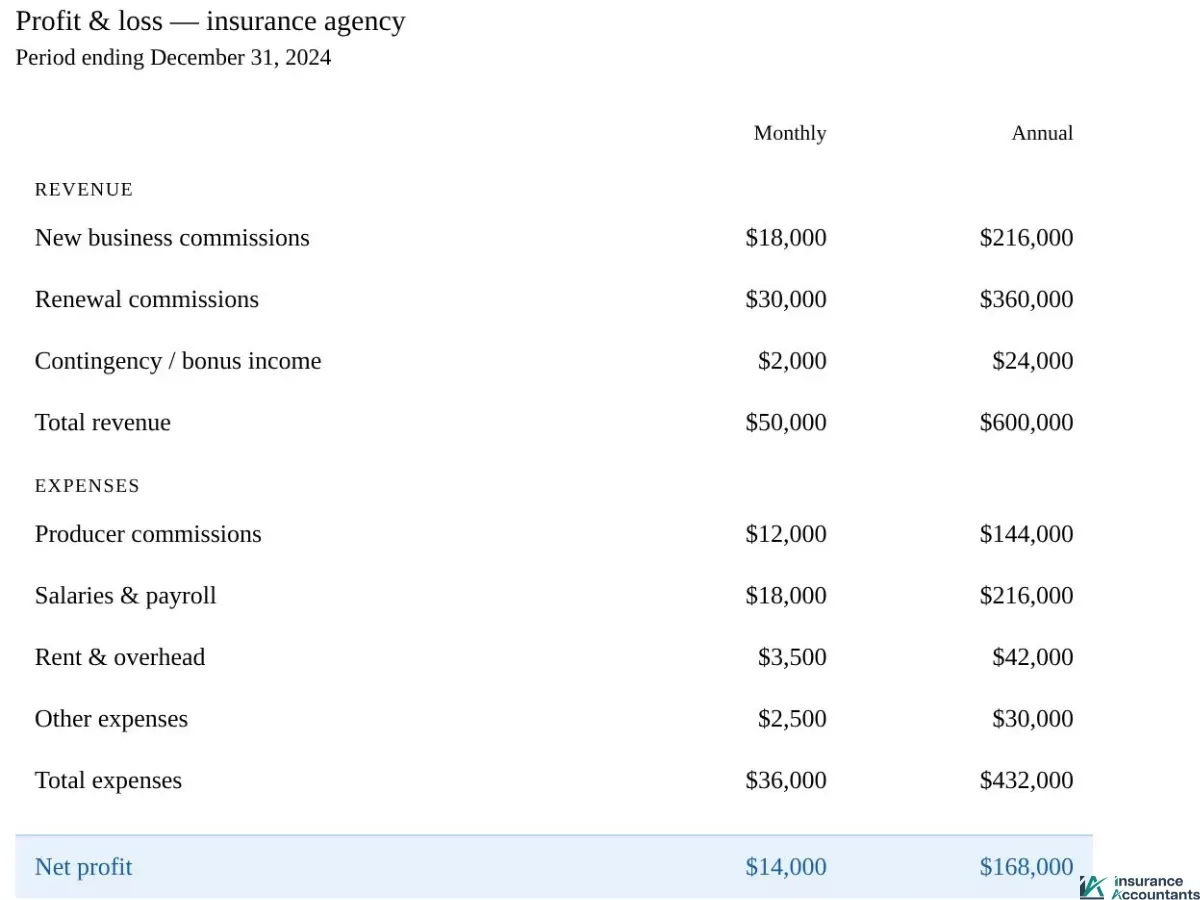
A profit and loss statement (P&L) provides a snapshot of how much money your agency made and spent over a specific period. It helps you understand if your business is generating a profit or loss over a specific period. You can complete a P&L monthly, quarterly, or yearly, depending on how often you want to track your financial performance.
In addition, a statement of profit and loss serves a different purpose than a balance sheet. While a P&L tracks income and expenses over time, a balance sheet shows assets, liabilities, and equity at a specific moment. It also accounts for depreciation, which reflects the gradual reduction in the value of long-term assets like office equipment or company vehicles.
Reviewing this statement shows whether income exceeds expenses and helps calculate gross profit for better decision-making. It’s an important way to track your agency’s overall performance and identify areas for improvement. This information also plays a key role in your agency's valuation, giving potential investors insight into its financial performance and growth potential.
We handle your P&L, bookkeeping, and commissions so your numbers are always accurate.
Get Your Books in OrderKey P&L Financial Metrics to Know
- Gross margin - the revenue remaining after direct costs are deducted
- EBITDA - core operating profit before taxes, interest, and depreciation
- Net Profit - total earnings after all agency expenses are settled
- Revenue Growth Rate - the pace at which your agency's income is increasing
- Operating Expense Ratio - the share of revenue consumed by day-to-day costs
- Owner's compensation - the principal's pay drawn directly from agency profits
How To Read a Profit and Loss Statement
Understanding these categories is essential for interpreting an insurance company's profit and loss statement.
1. Revenue: The Money Coming In
Revenue refers to the total income generated by your agency. This includes:
- Commissions - The primary source of income for most insurance agencies. Commissions are earned from the sale of insurance policies to policyholders, including new business and renewals.
- Other Income: Any other money your agency earns, such as fees for services or bonuses from carriers. This additional revenue is recorded on your income statement alongside your agency’s main earnings and expenses.
2. Cost of Goods Sold: The Direct Costs
This category includes costs directly related to earning your revenue, such as:
- Commissions Paid to Agents - If you pay commissions to other agents, these costs fall into this category.
3. Operating Expenses: The Ongoing Costs
Operating expenses cover the ongoing costs of running your agency, including:
- Salaries and Wages - For employees, agents, and other team members.
- Office Expenses - Rent, utilities, and office supplies.
- Insurance and Licensing Fees - Costs associated with maintaining the licenses and insurance policies your agency needs.
- Marketing Costs - Direct advertising or promotional costs aimed at bringing in business. For example, if your agency runs a digital marketing campaign targeting commercial insurance customers, the cost of those ads would be included here.
4. Net Income: The Bottom Line
Net income is the ultimate indicator of your agency's profitability, and keeping a close eye on it is a fundamental part of insurance agency bookkeeping and accounting. It's calculated by subtracting all expenses (COGS and operating expenses) from your revenue. A positive net income means your agency is making money; a negative net income means your agency is operating at a loss.

Why Understanding the Accounting for an Insurance Business Matters
For independent agents, the P&L insurance statement can seem complex, but it’s crucial to know how to interpret it. Your agency is likely managing multiple accounts, policies, and commissions from different insurers, so understanding how these accounts come together on your P&L statement is essential. This knowledge allows you to:
- Track Revenue - See exactly how much income your agency is generating from various insurers and adjust your strategy accordingly.
- Manage Expenses - By tracking your costs, you can spot inefficiencies and reduce unnecessary spending.
- Plan for Taxes - Understanding your net income will help you prepare for tax season and ensure you're setting aside enough for your tax obligations.
Common Challenges with Insurance Agency Accounting
Many independent agents face challenges when it comes to accounting for their business. Here are a few common pitfalls:
- Underestimating Expenses - It's easy to overlook small, recurring expenses that add up over time.
- Misclassifying Revenue - Accurately categorizing revenue sources is key to understanding your agency's financial health.
- Failing to Track Commission Payments - Keeping track of commissions owed to agents can become complicated, especially when working with multiple carriers.
If you’re not familiar with accounting for the insurance business, consider working with a professional accountant to ensure you’re capturing all relevant financial data.

Why Your Agency Needs a P&L Insurance Specialist
Partnering with an insurance accountant can transform how your agency handles money. Here's why it's worth it.
- Overwhelming finances - Managing your agency's finances on your own can quickly become overwhelming, especially when you're juggling policies, commissions, and day-to-day operations. We often see agency owners spending hours each week buried in spreadsheets and reconciliations that a dedicated accounting specialist could handle in a fraction of the time.
- Long-term savings - While hiring in-house or doing it yourself may seem like the cheaper route, the cost of errors, missed deductions, and compliance issues adds up fast. Most agencies we work with are surprised by how much money was left on the table before Insurance Accountants stepped in to restructure their books.
- Industry expertise - Insurance agency accounting comes with its own set of rules, and a general accountant simply may not know what they don't know. In our experience, agencies that switch to a specialist immediately notice the difference in how their commission structures, premium trust accounts, and carrier reporting are handled.
- Compliance and accuracy - Staying compliant with GAAP and industry-specific regulations is not optional, and the margin for error is slim. We often see agencies come to us after a compliance issue that could have been avoided with the right financial professional managing their reporting from the start.
- Frees up your time - Every hour you spend sorting through financial details is an hour you are not spending on growing your agency, building client relationships, or closing new policies. Our team handles everything from
tracking commissions to managing operating expense statements, so your energy goes where it actually moves the needle for your business.
From tracking renewal commissions to reconciling expenses, we manage the accounting so you don't have to.
Talk to an insurance accountantBest Practices for Using Profit and Loss Statements in Your Insurance Agency
To make the most of your P&L for an insurance agency, follow these best practices:
- Review regularly - Delaying P&L review until year-end allows small financial issues to grow into larger problems over time. We often see agencies catch cash flow gaps and commission discrepancies much earlier simply by building a monthly review into their routine. Professional insurance accounting services make that process a whole lot easier to stay consistent with.
- Analyze for trends - Look for patterns in your revenue and expenses over time, whether that's a steady increase in sales or expenses rising faster than income. In our experience, agencies that track trends consistently are far better positioned to make proactive decisions before a problem affects their bottom line.
- Benchmark against the industry - Understanding industry averages for insurance agencies helps you evaluate whether your spending and profit margins are actually competitive. Most agencies we work with are surprised to find they are overspending in areas like marketing or administrative costs once they see how their numbers stack up against peers.
- Separate revenue streams - Lumping all your income together makes it nearly impossible to see which lines of business are actually driving growth and which ones are underperforming. Our team recommends breaking out commissions, fees, and other income sources so you get a clear picture of where your agency's money is really coming from.
- Let your P&L shape decisions - Commission patterns, weak lines, and expenses help shape pricing, staffing, and carrier mix. At Insurance Accountants, P&L data is turned into action that reduces costs, grows revenue, and supports future growth planning.
Staying on top of your insurance company's profit and loss statement ensures your financial security, supports your agency's solvency, and positions it for sustainable growth.
Frequently Asked Questions
What Are the Two Types of P&L?
You can prepare a profit and loss statement in one of two ways: using the cash basis or using the accrual basis. The cash method tracks income and expenses at the point of payment, while the accrual method logs them the moment they are earned or owed.
Why Is a P&L Important?
After all costs are accounted for, a profit or loss is shown clearly through the P&L. Without it, measuring performance or planning for growth becomes nearly impossible.
What Are Common P&L Mistakes?
Common mistakes include mixing personal and business expenses and misclassifying revenue streams. We often see agencies skip regular reviews, which lets small issues grow unnoticed.
What Is the Purpose of Profit And Loss?
A profit and loss statement shows you how much money you made, what you spent, and what your expenses were over a certain period. It forms the foundation for budgeting, tax preparation, and strategic decision-making.
Why Is It Called Profit and Loss?
The name reflects the two possible outcomes: either earning more than you spend or spending more than you earn. It is a straightforward way of framing a business's overall financial result.

Optimizing Financial Performance Through Accounting for Insurance Business
Understanding how to interpret a P&L insurance statement is essential for any independent agent. With the right knowledge, you can make better financial decisions, reduce costs, and increase your agency’s profitability.
At Insurance Accountants, we take your financial data and transform it into a clear roadmap for growth through our insurance agency accounting and bookkeeping services. From managing payroll to reviewing cash flow statements, our team handles the financial heavy lifting. Contact us today to start improving profitability and move your agency toward stronger financial performance.